How times change. I would like to know if Pope Franziskus would still support what his predecessor promised 920 years ago - at least for the members of the Catholic Church - that by going to the holy land all your sins are forgiven. Ok, to be honest you needed to do more than just going there. The journey itself was taking ages (months or even years depending how rich you were) and many never returned home, but I'd bet the Roman Catholic Church would have a big problem in their reasoning of being a good Christ nowadays...
Just like the moral aspects in Christianity are obviously flexible and have changed over the centuries, other things changed as well. For instance the holy land is today only a four hours direct-flight away from Basel. I had no sins to forgive (at least none where the Roman Catholic Church would be of any help) but I thought this is good enough to make a tour through Israel visiting the major historic and cultural places. Well there are also some things that did unfortunately not change, like the whole region still being in tension, and violence and wars rising up from time to time. Same was for me, when my targeted travel period was getting closer and closer, the Hamas was still attacking Israel with missiles and Israel invaded the Gaza Strip... so I thought about postponing it to next year, but by doing that I thought I could run into the same problem again and I maybe end up doing it not at all. So I decided to cancel the travel- through-Israel part, and focused on Jerusalem for an extended weekend trip.
Jerusalem is the very center of the three monotheistic world religions - Christianity, Islam and Judaism. Monotheistic means, that every of these religions knows only one universal CEO with his own Messiah. Jesus (Son/Prophet), Mohammed (Prophet) and.... in fact here it's not 100% true since the Jewish leaders at that time did not accept Jesus as Messiah and rather sold him to the Romans - which eventually killed him. So the Jewish are still waiting for their hero to arrive. For the Christians it`s the holiest city with the Holy Sepulchre, for the Moslems it`s the third holiest city (after Mecca and Medina) with the Dome of the Rock and the Al-Aqsa Mosque, and for the Jews Jerusalem is their "eternal and indivisible" capital with the Western Wall as last remains of Salomon's Temple.
Once the plane departed, I immediately realized that this was not a flight like the others before. Soon after the belt signs went off, many men stood up, put a special cloak on as well as other religious things on their heads and arms, took the Tora, gathered in the passage between the seats and started this very typical way of praying where they close their eyes, whisper, and nod with the body back and forth all the time. The stewardess was not that much amused of course (EasyJet flight^^), but she didn't really hinder them to do so. This religious atmosphere accompanied me during my whole stay, but well its Jerusalem so what else do you expect...
When you are arriving at Ben Gurion Airport in Tel Aviv, there is a pretty easy and cheap way to get to your Hotel in Jerusalem if you are a bit flexible and have some time. Directly in front of the exit are group taxis waiting for a direct ride. They are called "Sherut", have around 10 seats, and depart once they are full. When you arrive at "normal" times during the day, you should not need to wait longer than 15 - 20mins for the next cycle, and they bring you either directly to your hotel or to a place nearby.
Day 1 | Market - Yad Vashem - Holy Sepulchre
 My first visit on arival day was the Mahane Yehuda Market, a big and very old market where you can get all types of local foods. It's crowded of course, and from a hygienic standpoint I wouldn't buy any meat or fish there...but the different types of spices, teas and local sweets look or respectively smell really tempting.
The Yad Vashem World Center for Holocaust Commemoration with the "Alley Of The Righteous Among The Nations" was my next stop. Walking through it, I was surprised how many Germans have a tree there apart from Mr. Schindler...

Right next to it is Mount Herzl, the center of the World Zionist Organization. Theodor Herzl was an Austrian-Hungarian publicist... if you're interested follow the link ;).
 In the evening I wanted to participate in the closing of the Holy Sepulchre (Grabeskirche), and before that of course have a look inside. What I realized immediately after entering the church, is that it smells like rose water...the reason I found out later. In fact this church is not only one church, but I think 17 in one! Since the roman Christianization when the very first church was built at this place up to today many different rulers and factions build their own altars and chapels inside or expanded the church. So you can find lots of smaller and bigger ones upstairs, downstairs and so on. In the lower sections I found one from the "Kingdom of Jerusalem", which was a Crusader State during 11th and 12th Century.
 |
| Deep down in the Holy Sepulchre |
Today the different factions like Greek-Orthodox, Roman-Catholic are represented by the Franciscans and Armenian Christs - Protestants are not represented - they all have their own times when they "own" the church for their prayers and rituals. These times are sharp and it can bring serious trouble if they are not followed...I was listening a priest explaining it like "you know we are all gods' children, and every child wants to be as close to him as possible so that's why they argue so hard about it...". Among all the groups I saw during my stay, I found the Armenians as the straightest. All priests and servants from the other groups where grown men, most of them old, but the Armenians were around 20 years old.
 |
| Only 30 seconds to go |
 |
| If it helps....? |
 |
| Armenian Priest |
 |
| Damascus Gate |
The Arabic part - at least as far as I can compare to the Jewish parts I've seen - is dirtier, less lit and offers less infrastructure than the Jewish. F.i. the receptionist at the hotel warned me not to use any ATM in the Arabic part of the city... I felt reminded of my stay in Rio de Janeiro...
Day 2 | Museum - Via Dolorosa - Western Wall
The next morning the receptionist from the evening before was still there (and even that day in the afternoon when I quickly checked in before going to the Market he was still there). He prepared me a... one might can call it "Spartanian breakfast". But ok maybe I was really the only guest in the hotel (I have not seen anyone else at the breakfast), or this is the typical breakfast in terms of size here, I don't know so I took what was offered and left for the city. The humus was delicious I have to say though.
On the way to the Tower of David Museum I quickly stepped into some of the small stores selling fruits, bread and sweets to replenish my stock for the day. You can get the round flat breads everywhere with all types of filling, it's really good. Also the fruits which you can get from the plenty little shops are good. And like with everything sold in the Arabic quarter you can negotiate prices, but from my perspective food is so cheap that I didn't do it at all.
The Tower of David Museum is a must do if you are interested in the history of the city. Of course there are many more Museums with special topics, but this one covers the complete story from the Jewish people and Jerusalem since the very beginning, going through all the centuries up to modern times with nice exhibitions and models, both archeological excavations and manually prepared. It's located at the Jaffa Gate in the big castle you can't miss it.
If you take some time to read, it really gives an idea about the Jewish history...and in general it's not a nice history. I don't want to go too much into details, but apart from the first and second temple period when the Temple Mount - which holds the Dome of the Rock (Felsendom) today - was the foundation for the Temple of Salomon, the Jewish people were ruled by a foreign ruler. The Babylons, Alexander the Great, the Romans, Islamic rulers, the Crusaders and again Islamic rulers to mention only some of them. And after the First World War when the Ottoman Empire vanished, the region was under British Mandate. Only when they left in 1948 the state of Israel recovered its sovereignty... and found itself immediately in war with Egypt, Saudi Arabia, Lebanon, Iraq, Jordan and Syria which wanted to bring the region back under Arabic leadership. Although this war is over, I guess Israel is the state with the worst relationship to its neighbors, you can witness this on the news regularly. I don't want to justify or choose sides at all, but it gives you an idea about how the Jewish people think in their politics...btw you can see this eventful history everywhere in the city on the street signs. They are in Arabic, Jewish and English language, and depending who was the current ruler when the sign was placed (or replaced ) he his language on top... the little daily power struggles that take place...
What you also see there is the common ground which still connects all three religions together. Going into details would fill books, but just to provide a short glimpse, we all know Jesus himself was a Jew, so Christianity evolved out of Judaism (which is the oldest of these three), and Jesus is also a prophet in the Quran. On Mohammed's night journey which led to his ascension to heaven he prayed together with three other prophets among them Jesus, and moreover all three religions claim a guy named Abraham as their primogenitor (that's why they are also called "Abrahamistic Religions"). I'm not a religious person but at least that's what the books say ;)
Enough religion lessons for now, after I left the Museum I wanted to do the wall tour, walking around the old city on the historic wall. But I was too late. It was already afternoon and the sun was burning, so I was not too much frustrated to escape a sunburn. So I headed back to the Via Dolorosa (translated "Street of pain") because every Friday at 3pm the Franciscans start the procession along the Via Dolorosa praying at certain stops, followed by all the pilgrims...and other just interested tourists like me. For that I needed to cross the old city from south west to north east, and happy me I had enough time for that because I forgot that on Friday there is also the Friday prayer for the Moslems which finishes around 2pm (only mandatory for men on Fridays). And after 2pm there is absolutely no way of walking in the old city towards the temple mount! The streets are narrow and there are masses flooding the old city center from the temple mount towards the gates, so there is only one direction possible during that time.
Finally I made it just in time at the Al-Omarya School today, back then it was the Palace of the Roman governor Pilatus. The procession starts at this place as Jesus was interrogated by Pilatus here. And very soon after the Franciscans started their talks (in Latin of course) the current balance of power became very obvious, because it was (again^^) praying time for the Moslems and so the Muezzins called with their well-known phrase "allahu akbar" (Allah is the Greatest) just like they do every day five times. And you can imagine there is not only one or two or five Muezzins in Jerusalem... so the poor Monks had to interrupt every second or third sentence to wait. The picture that this situation was painting in my head was very clear, and I guess it's true not only for this city but the whole region; even though the origin and the holiest places of their religion are in this area, the Christians are a minority, somehow trapped between the Arabs which are by far outnumbering the Christian inhabitants in the middle east, and the Jews with are also a minority, but with political and armed power. Here it's only about the power of voice, but in conflicts - especially armed ones - this can have much more dramatic effects (like in Egypt, Syria, Iraq, Islamic State etc.) These very old Christian communities, living there since ages, are minorities in their country, and are constantly endangered of being repressed, banished or worse. I guess this is globally the same and in the end leads to the question how mankind in general treats less powerful communities, people, creatures...
 The procession itself as I said follows the Via Dolorosa and ends up in the Holy Sepulchre. I was surprised to see many young people and also Asians following and praying, the picture in German churches is quite different. One of the last stops is on the roof of the Holy Sepulchre, here lives a small community of Coptic Christians. The roots of this community in Jerusalem go back to the 4th century A.D., and they still live a life without any technology... The last stop is then of course in the Holy Sepulchre. I guess Mel Gibson made a pretty realistic presentation of the happenings back then with his movie "The Passion of the Christ". You should be used to blood, the torturing scenes are...
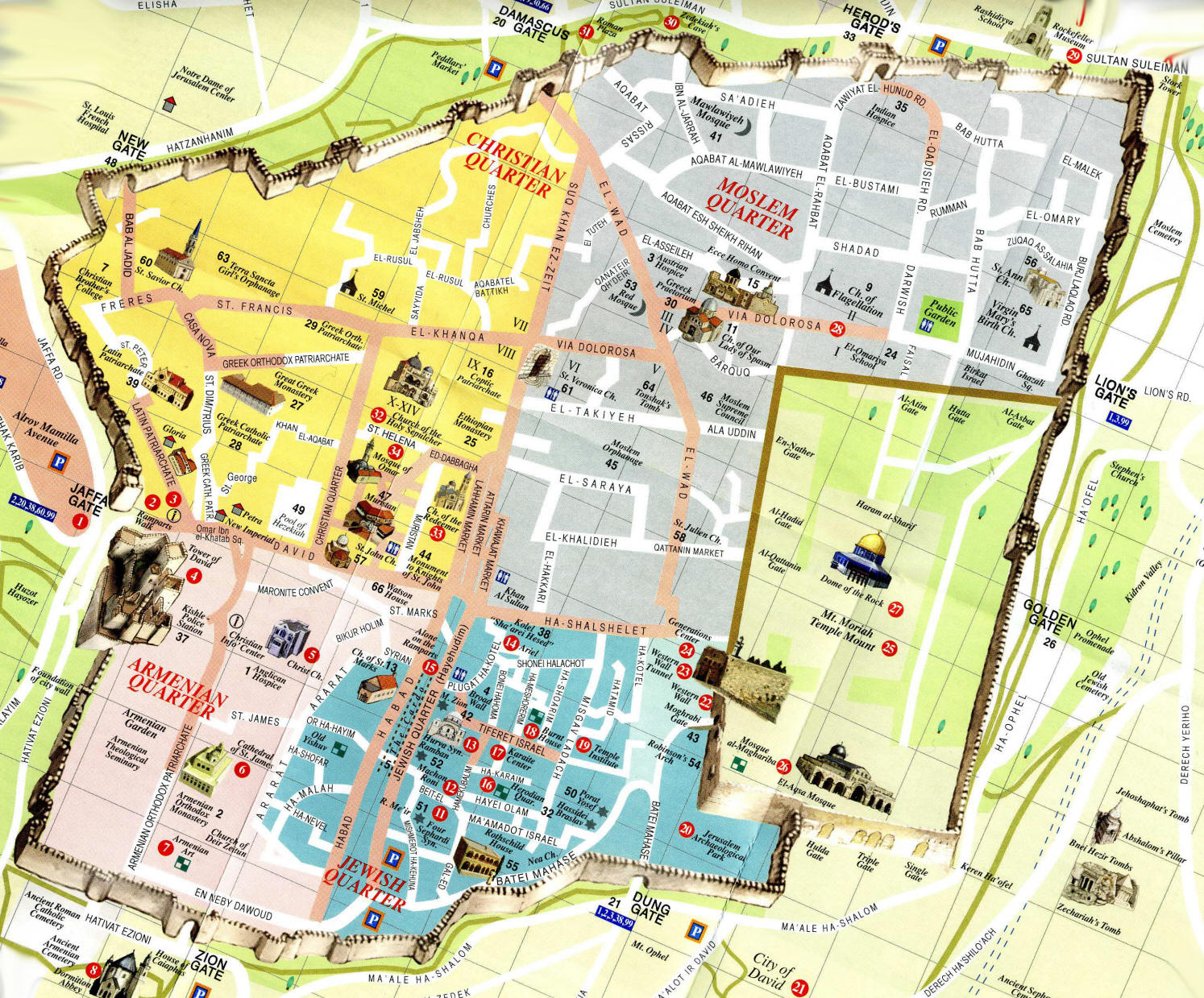
After the procession had finished I didn't have any further plans, so I just spent the evening hanging around in the old city. Thus is separated into different quarters, Islamic, Christian, Armenian and Jewish quarter. I was wondering why three of the four quarters have a religious background, but Armenia is a state or historically seen at least a region but not a religion...
I had dinner in a very small restaurant in the Arabic Quarter - I guess I wouldn't find it again since the road network in the old city is like a labyrinth, I was only orientating on directions. While chilling there I was watching the tourists slowly leaving the city and the shops closing. After that I wanted to go to the Western Wall (Klagemauer), and on my way through the Islamic Quarter, it was about 8 pm - I encountered a group of 10 - 12 young Jewish males, they were dancing and singing through the Arabic quarter, guarded by four heavily armed soldiers with machine guns. The Arabic inhabitants and shop owners, who were still on the street, apparently felt provoked by that act. But since they had no other option, they started knocking on their doors and garages to drown the Jews with their own noise. And in between these groups the Jewish soldiers with their weapons loaded... This went on for some time and the number of Arabs was steadily growing. Finally the Jews left towards the Jewish quarter... I found it weird and also a bit scary. As observer you could feel the tension and the rejection on both sides, where in this case clearly the Jews provoked it, knowing that they are well secured.
 When you want to go down to the Western Wall itself, you need to pass a airport-like security check. Finished that I stepped on the open place in front of the wall and watched the scenery. The place and the wall was quite full with praying Jews, also many many orthodox Jews among them, they are easy to recognize with their clothing and hair/beard style. The separated section for men is much bigger than for women, a saying says they have more sins to confess^^. What I also realized is that women walk away from the wall backwards avoiding to turn their back towards the wall. According to the history the Western Wall is the last remains of the Temple Salomon (destroyed by the Babylon's) and the second Temple (destroyed by the Romans), back then when the Jews had their own state.
To sum it up Friday is obviously a pretty religious day for all three religions in Jerusalem, starting with the Friday prayer for the Moslems, the processions from the Franciscans and in the evening there must have been some specialty in Judaism also, because the western wall was much more crowded, and the orthodox present were wearing special clothes compared to the other days or during the day.
When I came home to my hotel, the receptionist was still there...and it was still the same one as all the time since my arrival. He was watching TV - a show named Arab Idol - a singing contest like we all know them. And he was excited that a Asian girl was singing in Arabic with - according to him - very good pronunciation, almost no accent. It was funny, the picture you saw was absolutely not matching the picture in your mind when you closed your eyes. He was Israeli Palestinian, and since his English was pretty good we came into a conversation about Arabic language, the city, the current situation, his family, history, Islamic State, the different directions in Islam and Christianity and so on... He was really very polite and open minded and I enjoyed our talks, this was first hand impressions, feelings, thoughts etc. from a local. He said he is working five days in a row 24 hours, then driving home to his wife and seven kids for two free days. He was sleeping in the lobby on a couch during that time. I told him about my event with the Jews in the Arabic quarter, and asked him how he feels about the current situation, he said in a friendly and relaxed way; you know they have all been here, the Babylons, the Romans, the Crusaders and they have all been kicked out. Now the Jews are the ruling power here and at some point of time they will also be kicked out. But we have always been here and will always be here... Of course I also asked him about Islamic State and in this topic we both have the same opinion (which I don't think I need to explain here). They are also killing Shiites (a direction in Islam like Sunnis - comparable with Protestant and Catholics) where ever they find them, so I got the feeling the Islam is maybe also at a stage where Christianity was 400 years ago with the 30 years' war in Europe.
We talked more than two hours, and I only left because I was so tired and also had an appointment early next morning, but it was already late after midnight when I went to my room. But before I left he gave me his little English pocket Quran as a gift. He said I should be able to have a look and think by myself whenever I have a question. I could not refuse, but was a bit ashamed because I had nothing to offer in return...
Day 3 | Mount of Olives - Old City in general
My appointment next morning was a private day tour, the guide was 32 years jewish guy, he picked me up at the hotel. He was relaxed...he had no plans for the day leaving it entirely up to me what I'm interested in. Since I already visited the major spots in the old city we went up olive mount, from there you have a great view on the old city center with the Dome of the Rock. Walking down the hill we passed a very old Jewish cemetery, he said it's impossible to get a place on this cemetery for "normal" people because everybody wants to get buried here. The reason for that is religious (what else). In Judaism it's said that the Messiah for the Jewish folk will enter the city through the Golden Gate. From the cemetery you have a perfect view on this gate and so all Jews buried here will be able to witness the arrival of the Messiah........if he has good tools with him, because the Moslems these rascals just walled up the gate in 16th century... I leave this uncommented ;)
Inside the old city we visited some spots which I have not seen before like the Austrian Hospitz for instance, excavation sites from the Romans, and a hostel with a nice lounge in the shade on its roof, from where you have a nice view on the western wall and the temple mount. Talking to him was also very interesting, because it also gave me a first-hand picture from the other side of the conflict since he was Jewish. He said the state Israel basically has two opponents - number one is the Arabic Islamic world at its borders, the other one is the very orthodox Jews inside. They spend their life studying the Tora to understand how a good Jew should live, they don't have regular jobs but live mostly on unemployment assistance. They also don't go to military service, and they also refuse the state Israel because it does not follow the rules written in the religious books. So on one hand they are a burden for the state (at least economically), on the other hand they also refuse the hand which feeds them....weird situation. But having this in mind its maybe easier to understand the politics from Israel Premier ministers, because this very radical faction is growing, and they request strong actions against the Arabic opponents, since in their religious writings, this is the land for the Jewish folk....fuel for the never ending conflict.
The Dome of the Rock also has a
fascinating story...originally built as a Mosque, the Crusaders just
turned it into a church when they conquered the city...well
Christianity... flexibility... we had that topic...
He also told me why there is still an Armenian quarter in Jerusalem. He said they are Christians, but since all the time they were not really choosing sides, just did their prayers, and even today they don't involve in any local politics or other topics. So that's why they survived all the time, and also today he couldn't remember any confrontations or disagreements where the Armenians are even mentioned... I would say with them it's like with Switzerland...they don't choose sides because they either don't care, or they don't know which side Chuck Norris backs up ;)
The difference between the quarters is obvious. The Armenian and Jewish quarters are very clean, quiet, not many people in the streets, only some shops, bars and restaurants, menu cards outside with prices. You basically don't see Arabic people here, only some working in the shops. The Islamic quarter is the complete opposite, it's much more crowded , dirty, loud, hectic, hundreds of small shops and small kiosks in every street, much more tourists, menu cards sometimes available - but without any prices on it. Reason is cultural of, and economical - the Islamic shops have three flexible price categories....for Moslems/Arabs, for Jews and for tourists (but of course you knew it already). The Christian quarter is located in between and is a mixture of both sides.
Another difference is the access to the three major holy sites. The Holy Sepulchre is free of
access for everybody all the time as long as it's open. The western wall also but you need to pass a security check. The Temple Mount with the Dome of the Rock and the Al-Aqsa Mosque is open to non-Moslems only on special days, the rest of the week it's only open to Moslems (guarded by Jewish soldiers^^). Also the excavation sites next to the Temple Mount are a source for disputes between Jews and Moslems, digging on the Temple Mount itself is forbidden by the Islamic administration. Discussing this further leads to the question who owns Jerusalem, or let's say to whom it belongs historically. And this, my guide said, is always a question how far you go back in history....pretty much true!
We also talked about how it could happen that most parts of the Arabic world are today quite behind the western world from economical, technological and scientific standpoint. When Occident and Orient had their first real clash during the Crusades, the picture was the opposite, and what is today called Europe benefited much more from this exchange than vice versa. Many examples underpin that (our number system 0-9 which replaced Roman numbers and which is much easier to calculate with). Friedrich II. from the noble family of the Staufer was King of Sicily, for a certain period also King of the Holy Roman Empire, and since 1225 also King of Jerusalem when he lead a crusade gaining access again to Jerusalem and other important places for Christian pilgrims after they had been lost to Saladin. He made that on a diplomatic way by signing a 10 years peace treaty. At his palace on Sicily (the famous Castel del Monte) he gathered all the savants, scientists, writers, translators etc. he could find, Christian, Moslem and Jewish. They lived and worked together, books from one world were translated, and new discoveries and knowledge was shared and written down. They even built their own library there, this became a hub of cultural transfer - an impressive achievement by that time! (And still a model, to follow today).
Compare the European capitals and their palaces back then with the Al hambra in Andalusia, Spain (by that time occupied by the Moslems) to see the difference. So what happened after
the Crusade period ended between 1350 and the end of the (later established) Osman Empire 1918. Both worlds clearly took a completely opposite path. Europe advanced over the centuries, the Arabic world was more and more left behind. There is this big cultural heritage, but the main economic pillars are resource selling (mostly oil) and tourism nowadays, both maybe not the most sustainable sources. Maybe this is also a reason why religiousness is - in general - higher valued or let's say more participated by Arabic than western European societies. It's not like a political concept like democracy or autocracy, like free market economy or planned economy which came up and have been left behind, which prevailed or not. Religion was always there and didn't fail yet, it provides answers and a clear structure, what to do or follow, and what not...less technology, economy, less options and possibilities....just a thought...
My tour guide said, in his eyes, the Arabic culture is (still?) more tribal. They miss a bigger picture, it's more focused on short term gains than on strategic success. More on my welfare or my families' welfare than on our welfare as a community or region....this hinders advance for the whole group or at least too many parts or the whole group are too much self-focused to move forward as a whole...also just a thought...
By the time it was late and his "working day" was over. Quite a relaxed one even he had to admit. So I was chilling my last evening in Jerusalem. Going back on the Mount of Olives to watch sunset and make some pictures. My guide warned me that I should take care up there, when the times are really tense, Jews got kidnapped there...but since I'm not a Jew I have nothing to fear he said and laughed. His farewell message before leaving was a joke saying; "Even though we sold him to the Romans, do you know why Jews envy Jesus? He is the most popular Jew ever alive"
 To make it quick the sunset and stuff was nice, and nothing really happened that evening. I also didn't feel insecure up there or at any time during my stay (despite the picture the media might tell in their news). But I also have to say that the number of soldiers I have seen was insane...
When I came home I wanted to say thank you and goodbye to the receptionist, but he wasn't there anymore, he left for his two day weekend. I was happy for him, but on the other hand I would have really liked to talk to him again.
Day 4 | Going Home
When you enter Israel you don't get a stamp in your passport, because you wouldn't be able to enter some other Arabic countries with it - great relationship. Back at the airport I was trying to hide the Quran from the security checks to avoid any possible questioning... unfortunately my backpack was not that big, they found it, and it was obviously boosting their motivation to screen me...thanks for utilizing all your technology and showing me every single piece Ihad carefully packed, including the sweets...
On my way back home I recalled a great talk which I had with a guy from Belgium at breakfast in our hostel in Rio de Janeiro at the FIFA WM 2014 in Brazil. We met each other the day before when we both were interviewed by Brazilian TV and then were seated next to each other on a couch to have a conversation in our national shirts serving as background while the reporter was talking in front of us.
So at breakfast we came into a conversation and when I told him that I plan to go to Jerusalem next, it turned out that he is a Professor for Theology and has - of course - also been there. We talked about the beginning and the meaning of religion. He said back then in the very early days of mankind, many things around the people happened every day which they could not understand. Who made the sun going up every day? Why do rivers always flow in this direction? Why do some people die without any obvious reason or sickness and so on. So for them in the beginning there must be a man or a group of man doing this and they prayed and sacrificed to make them happy. So one meaning of religion was to explain the unexplainable.
Another meaning was to unite the people - same religion meant same beliefs, same fears etc. same group. Also with religion you can give a community a common sense and set of rules to be followed for a good and harmonious life together (like the 10 commandments - similar things you can find in all other religions). And of course, it was to relief sorrows or have a person to blame when there is nobody else to blame (if they couldn't influence things, and/or didn't understand why things happened).
With mankind religion evolved too. Some religions vanished, some split up in new branches, but kinds of religion and spirituality accompany the whole human history.
Especially in Jerusalem I saw religion can be many things. It can be the reason for hope, acceptance, it can help to relief sorrows, or just bring joy and good feelings. It can bring answers or give you (inner-) strength...but it can also be the root cause of mistrust, rejection, arguments, pain, a source of hate or even violence.
What is religion for you?
I was not a religious person prior visiting Jerusalem neither I am leaving it. I observed it. What I can say is, religion is what you make out of it...

As-salamu 'alaikum (Friede sei mit Dir - arab. Grußformel)
-----
PS: Catchy Tune from an jewish artist about and with some scenes from the city
-----
Wherever you are, be all there.
Jim Elliot
Day 2 | Museum - Via Dolorosa - Western Wall
 |
| All-in-one: starter, main dish, & dessert |
 |
| Good Morning! View from my room |
 |
| Old city of Jerusalem (handcrafted) |
If you take some time to read, it really gives an idea about the Jewish history...and in general it's not a nice history. I don't want to go too much into details, but apart from the first and second temple period when the Temple Mount - which holds the Dome of the Rock (Felsendom) today - was the foundation for the Temple of Salomon, the Jewish people were ruled by a foreign ruler. The Babylons, Alexander the Great, the Romans, Islamic rulers, the Crusaders and again Islamic rulers to mention only some of them. And after the First World War when the Ottoman Empire vanished, the region was under British Mandate. Only when they left in 1948 the state of Israel recovered its sovereignty... and found itself immediately in war with Egypt, Saudi Arabia, Lebanon, Iraq, Jordan and Syria which wanted to bring the region back under Arabic leadership. Although this war is over, I guess Israel is the state with the worst relationship to its neighbors, you can witness this on the news regularly. I don't want to justify or choose sides at all, but it gives you an idea about how the Jewish people think in their politics...btw you can see this eventful history everywhere in the city on the street signs. They are in Arabic, Jewish and English language, and depending who was the current ruler when the sign was placed (or replaced ) he his language on top... the little daily power struggles that take place...
 |
| Mohammed's night journey |
Enough religion lessons for now, after I left the Museum I wanted to do the wall tour, walking around the old city on the historic wall. But I was too late. It was already afternoon and the sun was burning, so I was not too much frustrated to escape a sunburn. So I headed back to the Via Dolorosa (translated "Street of pain") because every Friday at 3pm the Franciscans start the procession along the Via Dolorosa praying at certain stops, followed by all the pilgrims...and other just interested tourists like me. For that I needed to cross the old city from south west to north east, and happy me I had enough time for that because I forgot that on Friday there is also the Friday prayer for the Moslems which finishes around 2pm (only mandatory for men on Fridays). And after 2pm there is absolutely no way of walking in the old city towards the temple mount! The streets are narrow and there are masses flooding the old city center from the temple mount towards the gates, so there is only one direction possible during that time.
Finally I made it just in time at the Al-Omarya
School today, back then it was the Palace of the Roman governor Pilatus. The procession starts at this place as Jesus was interrogated by Pilatus here. And very soon after the Franciscans started their talks (in Latin of course) the current balance of power became very obvious, because it was (again^^) praying time for the Moslems and so the Muezzins called with their well-known phrase "allahu akbar" (Allah is the Greatest) just like they do every day five times. And you can imagine there is not only one or two or five Muezzins in Jerusalem... so the poor Monks had to interrupt every second or third sentence to wait. The picture that this situation was painting in my head was very clear, and I guess it's true not only for this city but the whole region; even though the origin and the holiest places of their religion are in this area, the Christians are a minority, somehow trapped between the Arabs which are by far outnumbering the Christian inhabitants in the middle east, and the Jews with are also a minority, but with political and armed power. Here it's only about the power of voice, but in conflicts - especially armed ones - this can have much more dramatic effects (like in Egypt, Syria, Iraq, Islamic State etc.) These very old Christian communities, living there since ages, are minorities in their country, and are constantly endangered of being repressed, banished or worse. I guess this is globally the same and in the end leads to the question how mankind in general treats less powerful communities, people, creatures...After the procession had finished I didn't have any further plans, so I just spent the evening hanging around in the old city. Thus is separated into different quarters, Islamic, Christian, Armenian and Jewish quarter. I was wondering why three of the four quarters have a religious background, but Armenia is a state or historically seen at least a region but not a religion...
 When you want to go down to the Western Wall itself, you need to pass a airport-like security check. Finished that I stepped on the open place in front of the wall and watched the scenery. The place and the wall was quite full with praying Jews, also many many orthodox Jews among them, they are easy to recognize with their clothing and hair/beard style. The separated section for men is much bigger than for women, a saying says they have more sins to confess^^. What I also realized is that women walk away from the wall backwards avoiding to turn their back towards the wall. According to the history the Western Wall is the last remains of the Temple Salomon (destroyed by the Babylon's) and the second Temple (destroyed by the Romans), back then when the Jews had their own state.
 To sum it up Friday is obviously a pretty religious day for all three religions in Jerusalem, starting with the Friday prayer for the Moslems, the processions from the Franciscans and in the evening there must have been some specialty in Judaism also, because the western wall was much more crowded, and the orthodox present were wearing special clothes compared to the other days or during the day.
 |
| Old city jungle |
We talked more than two hours, and I only left because I was so tired and also had an appointment early next morning, but it was already late after midnight when I went to my room. But before I left he gave me his little English pocket Quran as a gift. He said I should be able to have a look and think by myself whenever I have a question. I could not refuse, but was a bit ashamed because I had nothing to offer in return...
Day 3 | Mount of Olives - Old City in general
 |
| The Jewish Messiah is expected to enter here....if he can |
 |
| At a house in the Christian quarter... |
 |
| ...nice! |
 |
| Dome of the rock from outside... |
He also told me why there is still an Armenian quarter in Jerusalem. He said they are Christians, but since all the time they were not really choosing sides, just did their prayers, and even today they don't involve in any local politics or other topics. So that's why they survived all the time, and also today he couldn't remember any confrontations or disagreements where the Armenians are even mentioned... I would say with them it's like with Switzerland...they don't choose sides because they either don't care, or they don't know which side Chuck Norris backs up ;)
 |
| ... and inside |
Another difference is the access to the three major holy sites. The Holy Sepulchre is free of
 |
| Old city streets look like a Labyrinth |
 |
| Bullet holes at Jewish quarter (from the last intifada) |
Compare the European capitals and their palaces back then with the Al hambra in Andalusia, Spain (by that time occupied by the Moslems) to see the difference. So what happened after
 |
| "Taxi!" |
My tour guide said, in his eyes, the Arabic culture is (still?) more tribal. They miss a bigger picture, it's more focused on short term gains than on strategic success. More on my welfare or my families' welfare than on our welfare as a community or region....this hinders advance for the whole group or at least too many parts or the whole group are too much self-focused to move forward as a whole...also just a thought...
By the time it was late and his "working day" was over. Quite a relaxed one even he had to admit. So I was chilling my last evening in Jerusalem. Going back on the Mount of Olives to watch sunset and make some pictures. My guide warned me that I should take care up there, when the times are really tense, Jews got kidnapped there...but since I'm not a Jew I have nothing to fear he said and laughed. His farewell message before leaving was a joke saying; "Even though we sold him to the Romans, do you know why Jews envy Jesus? He is the most popular Jew ever alive"
To make it quick the sunset and stuff was nice, and nothing really happened that evening. I also didn't feel insecure up there or at any time during my stay (despite the picture the media might tell in their news). But I also have to say that the number of soldiers I have seen was insane...When I came home I wanted to say thank you and goodbye to the receptionist, but he wasn't there anymore, he left for his two day weekend. I was happy for him, but on the other hand I would have really liked to talk to him again.
Day 4 | Going Home
 |
| "Sorry for the mess" |
On my way back home I recalled a great talk which I had with a guy from Belgium at breakfast in our hostel in Rio de Janeiro at the FIFA WM 2014 in Brazil. We met each other the day before when we both were interviewed by Brazilian TV and then were seated next to each other on a couch to have a conversation in our national shirts serving as background while the reporter was talking in front of us.
So at breakfast we came into a conversation and when I told him that I plan to go to Jerusalem next, it turned out that he is a Professor for Theology and has - of course - also been there. We talked about the beginning and the meaning of religion. He said back then in the very early days of mankind, many things around the people happened every day which they could not understand. Who made the sun going up every day? Why do rivers always flow in this direction? Why do some people die without any obvious reason or sickness and so on. So for them in the beginning there must be a man or a group of man doing this and they prayed and sacrificed to make them happy. So one meaning of religion was to explain the unexplainable.
Another meaning was to unite the people - same religion meant same beliefs, same fears etc. same group. Also with religion you can give a community a common sense and set of rules to be followed for a good and harmonious life together (like the 10 commandments - similar things you can find in all other religions). And of course, it was to relief sorrows or have a person to blame when there is nobody else to blame (if they couldn't influence things, and/or didn't understand why things happened).
With mankind religion evolved too. Some religions vanished, some split up in new branches, but kinds of religion and spirituality accompany the whole human history.
Especially in Jerusalem I saw religion can be many things. It can be the reason for hope, acceptance, it can help to relief sorrows, or just bring joy and good feelings. It can bring answers or give you (inner-) strength...but it can also be the root cause of mistrust, rejection, arguments, pain, a source of hate or even violence.
What is religion for you?
I was not a religious person prior visiting Jerusalem neither I am leaving it. I observed it. What I can say is, religion is what you make out of it...
Three books, three religions, countless dead and still so much common ground.
In the end it was and still is about good values.
السلام عليكم
As-salamu 'alaikum (Friede sei mit Dir - arab. Grußformel)
-----
PS: Catchy Tune from an jewish artist about and with some scenes from the city
-----
Wherever you are, be all there.
Jim Elliot